Sunday, 24 April 2011

Chinese wedding foods

Chinese wedding foods

Chinese food has special symbolism: mostly wishes of happiness, longevity, or fertility. The number of courses is also significant. At a Chinese wedding banquet, eight dishes are usually served – not including the dessert. In Chinese, the word “eight” sounds like “good luck.” (The words for “nine” and “long” are also homophones, words that sound the same but have different meanings. At a birthday banquet, nine dishes are served with noodles at the end.)
Nowadays, a wedding banquet starts with appetizers such as “dragon-phoenix” plates or cold plates which consist of various sliced meats, jellyfish, and various types of nuts shaped like dragons and phoenixes and served chilled. (Lobster in Chinese is literally “dragon shrimp” and in Chinese restaurants, chicken feet are referred to as “phoenix feet”). In a marriage, the dragon symbolizes the male role while the phoenix symbolizes the female role. (See Chinese Wedding Traditions for additional use of the Dragon and Phoenix symbolism.) This yin-yang dualism, opposite but not contradictory, is a key concept of taoism according to Professor George Lee of San Francisco State University. He and others believe that taoism and the yin-yang dualism prevades Chinese philosophy. Lee wrote that according to the Black Sect Tantric Buddhism, “man and woman form a family – the tao of marriage.” Therefore, having lobster and chicken at the dinner would represent balance in the new relationhip.
Regarding the specific menu selections you mention:
Shark’s Fin Soup. Soup usually follows the appetizers. The type of soup has some significance, for example, shark’s fin soup indicates wealth because this delicacy is very expensive.

Roast Suckling Pig. Roasted pork is a symbol of virginity. (The groom presents a whole roasted pork to the bride’s family at the engagement party.)

Peking Duck and Lobster. Red is the color for happiness, so serving Peking duck and lobster would signify joy and celebration. Also, serving the dish whole, i.e. with the head and legs, would symbolize completeness.

Squab (or Other Fowl). According to Shu Shu Costa, the author of Wild Geese and Tea, pigeon has tender meat that symbolizes peace. Usually two pigeons are offered to wish the newlyweds peace as they start their new life together. Squab (pigeon) is similar to quail, so they both probably symbolize peace. Quail is offered whole to each guest so each and every one will also experience a peaceful life. Serving fried chicken would wish the couple to have a good life because in Chinese “red chicken” sounds like “good life.”

Crab Claws. If you want to serve crab, I suggest you serve the whole crab and not just the claws, which is separated from its other parts. Since you will serve lobster, I recommend that you replace the crab claws with fried chicken because of my explanation above. A typical Chinese banquet usually includes chicken and duck.

Vegetables with Sea Cucumber. Serving sea cucumber with vegetables is a sign of selflessness because “sea cucumber” sounds like “"good heart” and this dish wishes the couple to think in a similar way – to avoid conflict.

Fish. Serving fish would hope that the couple will experience a life together with abundance because “fish”" sounds like “plentiful” in Chinese.

Noodles served at the end would symbolize longevity because noodles come in long strands.
Sweet Red Bean Soup and Sweet Buns. Serving dessert probably wishes the newlyweds a sweet life. The hot sweet red bean soup should contain lotus seeds (lian zi) and a bark-like vegetable (bak hop) to wish the newlyweds a hundred years of togetherness. The sweet lotus paste in sweetened steamed bread symbolizes fertility; it is shaped and colored to resemble peaches (ta zi), since the peach represents long life. The sticky dumpling you describe, covered with crushed peanuts with black sesame paste in the center, is called mochi.


At the end of the banquet, waiters usually pass out take-out boxes to the guests because there is usually enough food for everyone and some left over; this represents abundance. It is acceptable to take some of the food home because it is not good to waste good food – or anything else for that matter.
Tea, alcohol, and 7-Up are almost always supplied at a Chinese wedding banquet. Offering tea is a sign of respect. Alcohol is served to celebrate the special occasion. (In Chinese,“ going to a dinner banquet” is synonymous to “going to drink alcohol;” and in Cantonese, “to go drinking” literally means “go to a bar.”) And 7-Up sounds like “seven happiness,”, since the words for “up” and “happiness” are homophones.)
You might notice that Chinese restaurants have a big Chinese character behind the head table; it is the character for “double happiness” which is used during wedding events。

Friday, 22 April 2011

Traditional Hindu Bridal and Groom Wear

THE BRIDE
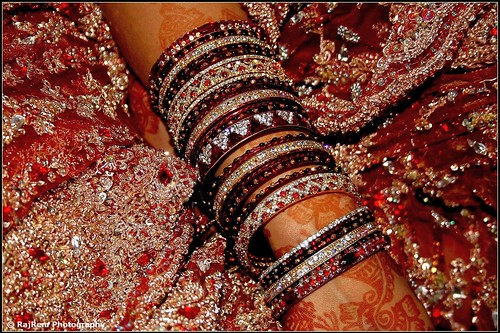
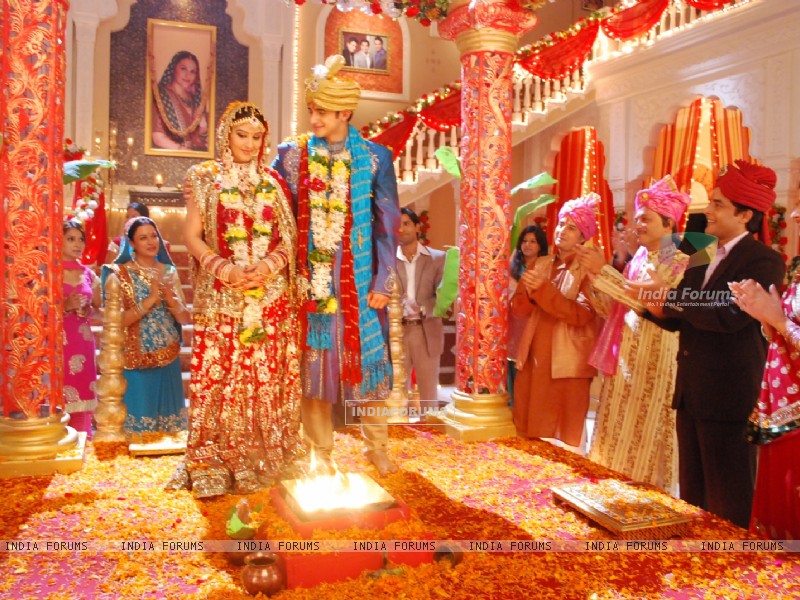
A Traditional Hindu bride always wears the colour red. A Hindu bride wears a sari or a lengha choli and ornaments. The lengha choli has heavy embroidery on it to make it seem beautiful. The bride usually plaits her hair or has it in a bun, with a veil around her head, which conveys respect. The bridal jewellery is made out of gold, silver, platinum or diamond. A red chunari or dupatta must be worn by the bride. She also wears red bangles, which must be made out of glass, bindi and vermillion. Her hands and feet are adorned with henna.


The jewellery that the bride wears is a maangtika, nathni, bangles, rings, toe rings, earrings, anklets. kamarbandh and necklace. The jewellery is usually in gold.
A maangtika is worn in the hair parting, which compliments the shape of your face.


A nathni (nose ring) has a chain attached to it, which is usually pinned or tucked in the hair, near the ear. They come in different sizes, some are big and some are small. There are also different designs. Even if you don't have your nose pierced, clip on's are available.


Red glass bangles are also worn, in both arms, with white bangles, which must be thicker than the red.


Kamarbandh is a chain that is designed for the bride to wear around the waist.


Rings, toe rings and anklets are worn, which are usually in gold.

toe rings
rings

anklets


And a necklace is worn which is in a set with the earrings.


The Hindu bride is to have henna on her hands and arms, as well as feet. The design of bridal henna is different from those who aren't getting married and it is said that the darker the colour of the henna, the better the relationship between the married couple. The groom's name is written with henna on the bride's hand.

THE GROOM
The Groom wears a Sherwani and a chudidar, with a matching turban. A pair of mojri are worn in the feet by the groom. A sehra is worn on the head.  Sherwani is a common ethnic groom wear which looks like a jacket, but without a collar.


The sherwani is long in length and reaches till the knees. The sherwani is worn with a churidar trouser along with a matching dupatta.


One of the most important wedding accessories for the groom is a sehra. A sehra is in the form of a turban and has strings of flowers hanging down. 

Mojris are traditional shoes that are worn by a Hindu groom.  These are slip on shoes that come in a variety of designs and colours. A matching pair of mojris maybe picked with the groom’s outfit.  Mojri s are point at the front and it coils up. It is has vibrant colours and is beautifully hand-crafted with mirrors and decorative beads.
The groom and the bride wish to look best on the most important day of their lives. A Hindu bride and groom are always dressed in colourful clothing. They are dress very differently and vibrantly.

Tuesday, 19 April 2011

Traditional Wedding Day Activities in China

  • Wedding Day: picking up the Bride

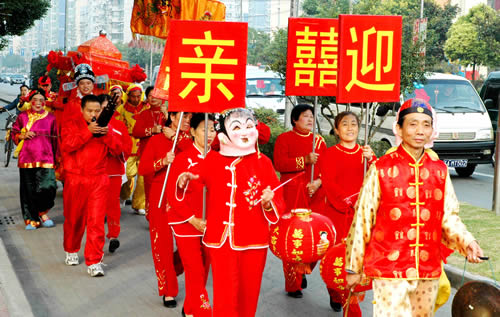
On the day of the wedding, the groom will send a carriage over to the bride's family to bring the bride home. The carriage is decorated in red and is carried by four servants. Musicians will accompany the procession and they will play wedding music all the way. A lot of gifts are also brought to the bride's family at the same time.
At the bride's home, the bride will put on her bright red wedding gown and the bride's parents will give her jewelry to wear.
  • Bride Leaving Home

As the groom's procession arrives, the groom's spokeswoman will enter the bride's house and will carry the bride on her back. The bride cannot touch the ground with her feet until she arrives at the groom's house. In some regions, the bride's relatives will throw rice into the air, hoping that the chickens around will eat the rice instead of pecking at the bride. Sometimes, a red umbrella is used to shield the bride as the opening of the umbrella will symbolize her bringing many descendants to the groom's family. As the bride leaves the house, her parents and her relatives will bid her farewell as she rides the carriage and leaves home. Wealthy brides often have servant girls who will follow her to the groom's family and continue to serve her. These maids are known as ones who 'accompany the marriage'.
  • Bride Arriving at the Groom's Home

After the bride arrive at the groom's house, the couple will again worship the ancestors and worship the heavens and earth. Then they will serve tea to the groom's family according the their seniority and the relatives will give them red packets or bridal jewelry in return.
  • The Wedding Banquet

To celebrate the marriage, the groom's family will throw a wedding feast as large as they can afford. In the old days, some villagers may use up to seven continuous days to entertain the relatives during a wedding. Every night, delicious food is being served to all the guests.
  • The Bride Returning Home after 3 Days

Nowadays in certain regions, this rule is still being followed where the bride will return to the family with gifts. However, in some regions, this custom is being simplified so the bride will return home on the same day if distance allows. Otherwise, some brides will leave the door, and then return to the house again and count that as 'returning home'.

Monday, 18 April 2011

The invitation cards for different weddings around the world

Chinese invitation  cards for weddings

The couple china still use the tradition of their ancestors, they believe the red color will bring luck to their marriage, they make gaum with motifs in red, red wedding invitations, red lanterns and some other decoration.  Even in these modern times, Chinese wedding couples try to find that some of their traditions and culture contribute.

Color does not like is the color green, black and blue. The color has a meaning of grief or mourning. In addition to using the red color, they also used the motif associated with the chinese, the bamboo tree and writing letters of gold color. Gold and silver letters used for the red-colored cards, but other colors can be used for different colored cards, race. Chinese wedding invitation card should also both English and Chinese version. Chinese language is written vertically and from left to right, where is the groom to the bride to represent information. The invitation for the guest’s name written on the envelope, where his / her formal title will be used. It is also stated that the spouse or whole family is invited, and how many seats will be reserved. It should be in addition to an invitation to the wedding reception, wedding special for weddings, especially if have two.China wedding cards to maintain the traditional style. They believe that it is the best, and we must admit that the design they use is very attractive, have characteristics and character.
How to design the invitation cards for Australia weddings

Theme weddings are a way to make your special day even more memorable. A western theme is the perfect idea for a weddings because it evokes thoughts of old time romance and adventure. Start your western wedding off with western-themed invitations. Buying personalized western invitations from a commercial company may be easy but is also probably expensive. Save moneyand get exactly what you want by designing your own western-themed wedding invitations.

Use classic western color combinations in your invitations, such as brown with muted greens, yellows, oranges and reds. Brown and pale pink or purple are more feminine, but still very western choices. Choose brown and cream for a classic western look.

Print a classic western logo on the card stock, such as horseshoes, cowboy hats, horses, tumbleweeds or wildflowers. Print the logo in one color to look like a silhouette, just a shade or two lighter or darker than the card stock you are using. The logo should take up at least half of the card stock. You want to create a subtle and elegant design.
Print your invitation wording in an elegant font on the card stock over the logo. The color of the font should stand out from the card stock and the logo. If your card stock is dark, use a light color for the font and vice versa. For a western flare, use old fashioned language to word your invitations.
Finish your western invitation design with some ribbon in a color that complements the card stock. The ribbon can be tied around the invitation at the middle, top, side, bottom or anywhere that looks good to you.

Add some kind of western accessory to make the invitation even more special. The accessory can match the logo you chose. For example, if you chose a wildflower logo, attach a packet of wildflower seeds to the invitation. If you cannot find an accessory that you like, add a picture of you and your soon-to-be mate dressed in old western wear.
Invitation cards for Indian weddings

 
Invitation cards play an important role in the marriage of the Indian community. Invitation card is based on the Hindu almanac. If something happens, meaning the marriage can not be carried out smoothly. Turmeric powder will be applied on the invitation cards as the symbol of harmony.
Several pieces of invitation cards in odd numbers will be brought together into the temple to be pray (arccanai). Card is placed on the tray with betel, money, oil, pinang as a symbol of wealth.
The ceremony is called paanam paaku. Then tray will be brought to the bride house to be given to the groom and the groom also will bring the tray to bride. At the same time sirih pinang will be given as a sign of invitation marriage officially.
The design of Japanese Wedding Invitations

You are having a Japanese themed wedding and want to do homemade printable Japanese wedding invitations, but aren’t sure how to go about creating them.
Here you can download a free template. The next thing you need to do is choose a design image that you can import into the template. Some of the designs you might consider using includes fans, butterflies, kimonos, geisha girls, cherry blossoms, poppies and lot us flowers.
Many designs use Japanese lettering to spell out words like peace, love and happiness.
You will want to use rice, parchment or linen paper to print your invitations. To add stability to your custom Japanese invitations, you may want to mount the rice paper on cardstock or other sturdy paper.
You can use our site to find wording samples that you can use for inspiration while writing your own invitation verse. Enjoy the process of creating homemade printable Japanese wedding invitations.

Sunday, 17 April 2011

Traditional Hindu Weddings

Hindu Weddings are said to be the bringing of two people who are compatible. Hindu wedding ceremonies are traditionally performed in Sanskrit. They have many rituals that differ from modern western weddings in many ways. Hindus convey a lot of importance for marriages, and the ceremonies are very colorful and continue on for several days.

The wedding must take place in a mandap (the four-polr canopy at centre stage) in the presence of a sacred fire. The sacred fire in the mandap symbolises not only the illumination of the mind, knowledge and happiness but it is also a clean and pure witness to the ceremony as it progresses. Seven encirclements are made around the sacred fire by the bride and groom together as they make their seven promises. The seven promises are:
  1. Let us take the first step to provide for our household, keeping a pure diet and avoiding those things that may harm us.
  2. Let us take the second step to develop our physical, mental and spiritual powers
  3. Let us take our third step to increase our wealth by righteous and proper means
  4. Let us take the fourth step to acquire knowledge, happiness and harmony by mutual love, respect and trust.
  5. Let us take the fifth step so that we may be blessed with strong, virtuous and heroic children.
  6. Let us take the sixth step for self-restraint and longevity.
  7. Let us take the seventh step to be true campanions and remain life-long partners by this wedlock.

The ceremony itself is a collection of rituals which is performed by both the bride, bridegroom and their respective parents and close relatives. The priest chants "mantras" from the Veds that were originally written in Sanskrit. The following things are used in the ceremony:
  •  Fresh flowers- which signify beauty
  • Coconut- to signify fertility
  • Rice, jaggery and other grains- to signify the food necessary to maintain a healthy lifestyle
  • Ghee (purified butter)- to feed the sacred fire
  • Kumkum (vermilion) - red powder which is used for marking the forehead to signify good luck and to convey that your husband is a part of your life.
In traditional Hindu weddings, the formal invitation is the only card announcing a marriage to the community. There are no arrangements for "save the date", "RSVP" or "thank you" cards. This is because a person may come with as many persons as he/she wishes to a hindu wedding. Guests aren't strict, no registration lists are required because most people attending the wedding would not have recieved a formal invitation. This is because it is common in a hindu wedding to have 500+ guests and most people are hence invited by word of mouth. Traditional Hindu wedding cards have Lord Ganesh printed on it because it is believed that Lord Ganesh brings prosperity and happiness to the marrying couple and their family.

Thursday, 14 April 2011

Wedding Customs in Oceania

Oceania primarily refers to Australia and New Zealand, two of the most remote countries in the world, yet two of the most exciting and vibrant countries on earth as well. Both New Zealand and Australia are members of the British Commonwealth and so they have borrowed many of their wedding traditions from Great Britain – although they have been flavored by the traditions of the native populations of both nations.


In Australia a wedding keepsake bible is handed down from generation to generation
The white wedding dress has been traditional on Australia for many centuries and is still popular today, symbolizing hope and joy for the future. It is traditional in Australia to give the bride a groom a keepsake bible as a wedding gift. Marriage bibles are treasured family heirlooms and are often passed down from generation to generation.

Traditionally Australian weddings include all members of the bride’s as well as the groom’s families. Family squabbles and differences are traditionally set aside on this special day so that the newlyweds can be blessed with a happy and joyous start along the road of their new lives together. Most Australian wedding traditions have been borrowed from England, but it is also common for Scottish and Irish wedding ceremonies to be performed in Australia, and many ceremonies are also flavored with Aboriginal customs. One thing that never changes, however, is the exchange of rings at the conclusion of the ceremony.
The wedding ring, a perfect circle with no beginning and no ending, symbolizes never-ending love in Australia just as it does in most of the rest of the world. An Australian wedding reception is apt to feature a wide range of music, everything from traditional English and American music to bagpipes and even the haunting melody of the Aboriginal didgeridoo.

In New Zealand it is considered bad luck for the groom to see the bride before the wedding.
The wedding tradition in New Zealand calls for a lavish church wedding, a white-gowned bride and all the bridesmaids. The groom wears dark pants and a white shirt and dark coat and he is flanked by his best man and his groomsmen. It is considered bad luck for the groom to see his bride on the day of the wedding before she walks down the aisle.

An additional aspect of a New Zealand wedding is the incorporation of traditional Maori wedding customs. The Maori are the native people of New Zealand and their customs and traditions are held in high esteem by many New Zealanders.
Maori wedding traditions are often incorporated into the New Zealand wedding ceremony
Maori wedding tradition includes the ceremonial Powhiri welcome to the bride and the groom, and may include the traditional warrior challenge. Often a New Zealand wedding is conducted by a Mario tribal elder and at the conclusion of the ceremony the couple is blessed in the Maori language.

And no Maori-flavored Oceania wedding would be complete without the “infinity loops” placed around the necks of the bride and the groom, symbolizing never-ending love.

It doesn’t matter it you are at the top of the world or if you are in the very heart of the land down, weddings bring out the best in everyone and call for joyous celebration the world over. In Oceania the traditions are a beautiful mix of the new with the ancient, creating a wedding experience that is unique to this very special corner of the world down under.

Traditional Japanese Wedding

Most of the Japanese wedding ceremonies will take place in spring and fall in Japan. The weddings are held at hotels or wedding halls where chapel and shrines are conveniently located within the facilities. A Japanese wedding ceremony may be Shinto, Christian, Buddhist, or non-religious styles. Couples choose the style of their wedding ceremonies, and it doesn't necessarily match with one's religion. Non-Christian couples often have their weddings at chapel in Japan.

             
The traditional Japanese wedding ceremonies are the Shinto-style and are held at shrines. Brides wear traditional wedding kimono called shiromuku (white kimono robe), and grooms wear montsuki (black formal kimono), haori (kimono jacket), and hakama (kimono pants).

With the Shinto-style weddings, it's normal just invited the family members and close relatives of couples attend Shinto-style wedding ceremonies. A ceremony includes sake drinking rituals, exchanging wedding rings, and more. There are neither bridesmaids nor a best man. Traditionally an older married couple called nakoudo (matchmaker) attend a Japanese wedding ceremony, but this tradition isn't often observed in recent years.

Once the guest receive an invitation card to the wedding reception, the guest need to return the enclosed card and let them know if you can attend or not as soon as possible. If you are attending a Japanese wedding reception, you are expected to bring cash for a gift. The amount depends on your relationship with the couple and the region, unless fixed amount is indicated in the invitation card. It is recommended to ask someone who is attending the same wedding. The average is 30,000 yen for a friend's wedding. It's important that the cash is enclosed in a special envelope called shugi-bukuro, and your name is written on the front. It's polite to use new bills with no creasing. When you go to the party, hand the envelope to the person at the reception desk and sign your name in the guestbook.